Industrial

Industrial Electrical Setup

Power Engineering for Manufacturing, Engineering & Processing Plants

Discuss this service
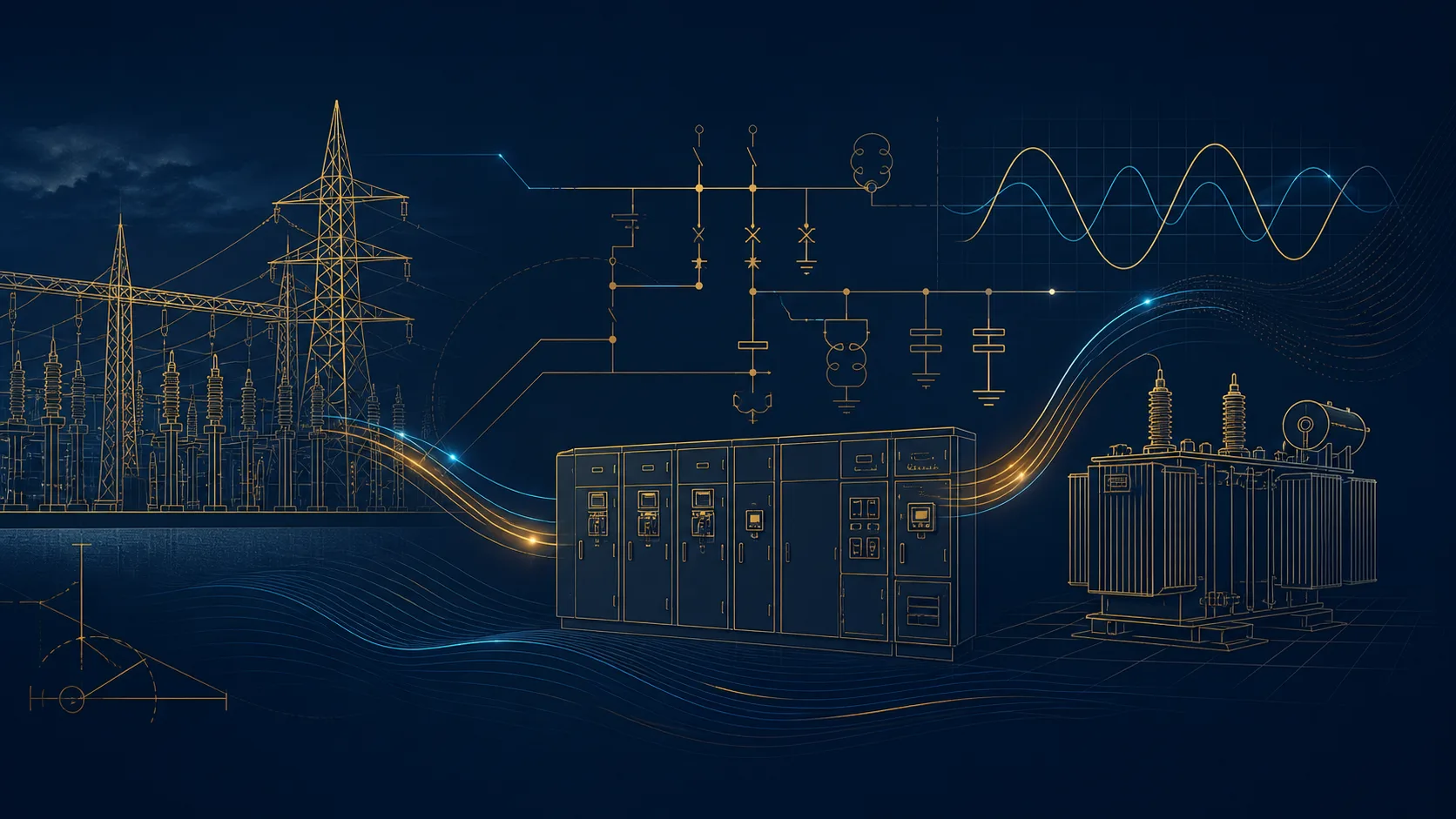
Illustrated electrical distribution system, switchgear and transformer

Overview

Engineering scope built around the project

Industrial facilities require robust electrical systems capable of supporting heavy motor loads, continuous operational cycles, and significant inductive demands. DV Consultancy Services provides specialized electrical engineering for industrial setups across key corridors including Butibori MIDC, Hingna MIDC, Wardha, and Chandrapur.

We design complete power distribution infrastructure up to 33kV, from incoming utility connections to switchyards, transformers, HT protection switchgear, and LT distribution centers.

Our engineering solutions account for motor starting surges, environmental conditions (dust, ambient heat, vibration), and power quality stability, with all designs developed in reference to CEA safety regulations and relevant Indian Standards.

Technical scope

What the engagement may cover

1. HT Substation & Switchyard Engineering (11kV / 33kV)

  • Switchyard layout plans, equipment clearances, and structural drawings referenced to CEA guidelines.
  • Transformer specification: vector groups, cooling methods (ONAN/ONAF), and protective accessories (Buchholz, PRV, OTI/WTI).
  • HT Protection schemes: Overcurrent (50/51), Earth Fault (50N/51N), and transformer differential protection.

2. Motor Control Centers (MCC) & Distribution

  • Segregated Form-partitioned LT switchboard layouts for safe operational maintenance.
  • Variable Frequency Drive (VFD) and Soft Starter panel integration with line reactor specifications.
  • Interlocking logic and control schematics for sequential machinery operation.

3. Power Factor Correction & Harmonic Detuning

  • Automatic Power Factor Correction (APFC) panel engineering with reactive power step calculations.
  • Detuned filter reactors (7% or 14%) to protect capacitor banks against harmonic amplification.
  • Thyristor-switched capacitor banks for rapidly fluctuating inductive loads.

4. Industrial Earthing Grid Design

  • Earthing grid conductor sizing based on calculated prospective earth fault currents.
  • Interconnected equipment body and neutral earthing networks as per IS 3043.
  • Class 1 and Class 2 surge protection coordination at main intake panels.

A clear engineering process

01

Machinery & Load Audit

Mapping connected motors, drives, furnaces, and auxiliary machinery ratings, duty cycles, and starting methods.

02

Fault Level & Cable Calculations

Computing prospective short-circuit levels and cable voltage drops across extended industrial runs.

03

Engineering Blueprints

Preparing single-line diagrams, panel GA drawings, cable tray layouts, and earthing grid blueprints in AutoCAD.

04

Technical Review & Coordination

Reviewing vendor panel submission drawings and providing commissioning advisory support.

Standards and project context

References below guide the technical conversation. The final applicable standards, authority requirements and issue dates must be confirmed for each project.

  • CEA Regulations (Measures Relating to Safety and Electric Supply)
  • IS 2026: Power Transformers
  • IS 13947 / IEC 60947: Low-Voltage Switchgear and Controlgear
  • IS 3043: Code of Practice for Earthing

Common client contexts

Manufacturing & Fabrication FacilitiesTextile & Spinning MillsChemical & Processing UnitsSteel Rolling & Engineering WorkshopsAgro-Processing & Cold Storage Plants

Frequently asked questions

Why are detuned filter reactors recommended in industrial APFC panels?

Industrial loads like variable frequency drives and rectifiers generate harmonic currents. Standard capacitor banks have low impedance at higher frequencies, which can lead to harmonic resonance and capacitor failure. Detuned reactors alter the resonant frequency below major harmonic orders, protecting the capacitor bank.

What information is needed to design an industrial HT substation?

Key inputs include the sanctioned contract demand from the utility (kVA), incoming supply voltage (11kV or 33kV), site layout dimensions, complete connected motor load schedule, and future expansion projections.

What earthing guidelines apply to high-voltage industrial substations?

Substation earthing is designed with reference to IS 3043 and CEA regulations, utilizing an interconnected earth grid to ensure that combined earth resistance is kept low (typically below 1.0 Ohm) to safely dissipate fault currents.

Related services

Residential

Residential Electrical Design

Engineered, energy-efficient, and IS 732-compliant electrical layouts and single-line diagrams for residences, villas, and housing societies.

  • Connected & Maximum Demand Load Calculations
  • Internal Conduit, Lighting & Power Point Layouts
  • Main Distribution Board (MDB) & Sub-DB Schematic SLDs
Explore service
Commercial

Commercial Electrical Design

High-reliability power distribution, backup generator synchronization, and life-safety electrical schemes for commercial and healthcare facilities.

  • Substation Layout & Dual Incomer Switchboard Schematics
  • Standby Generator (DG) & UPS Synchronization Schemes
  • Isolated Power Supply (IPS) Concepts for Critical Care Areas
Explore service
Testing

Equipment Testing & Calibration

Diagnostic electrical testing for circuit breakers, transformers, protection relays, HT cables, and earth pits using calibrated instruments.

  • Transformer Oil Breakdown Voltage (BDV) & Dissolved Gas Analysis (DGA) Advisory
  • Transformer Winding Resistance, Voltage Ratio & Magnetic Balance Testing
  • Insulation Resistance (IR) & Polarization Index (PI) Testing
Explore service
Project conversation

Need help planning industrial electrical setup?

Share the project stage, available drawings and site constraints. We will use that context to frame the next engineering step.

Discuss your requirement