Testing

Equipment Testing & Calibration

Diagnostic Health Assessments, Preventive Testing & Condition Reports

Discuss this service
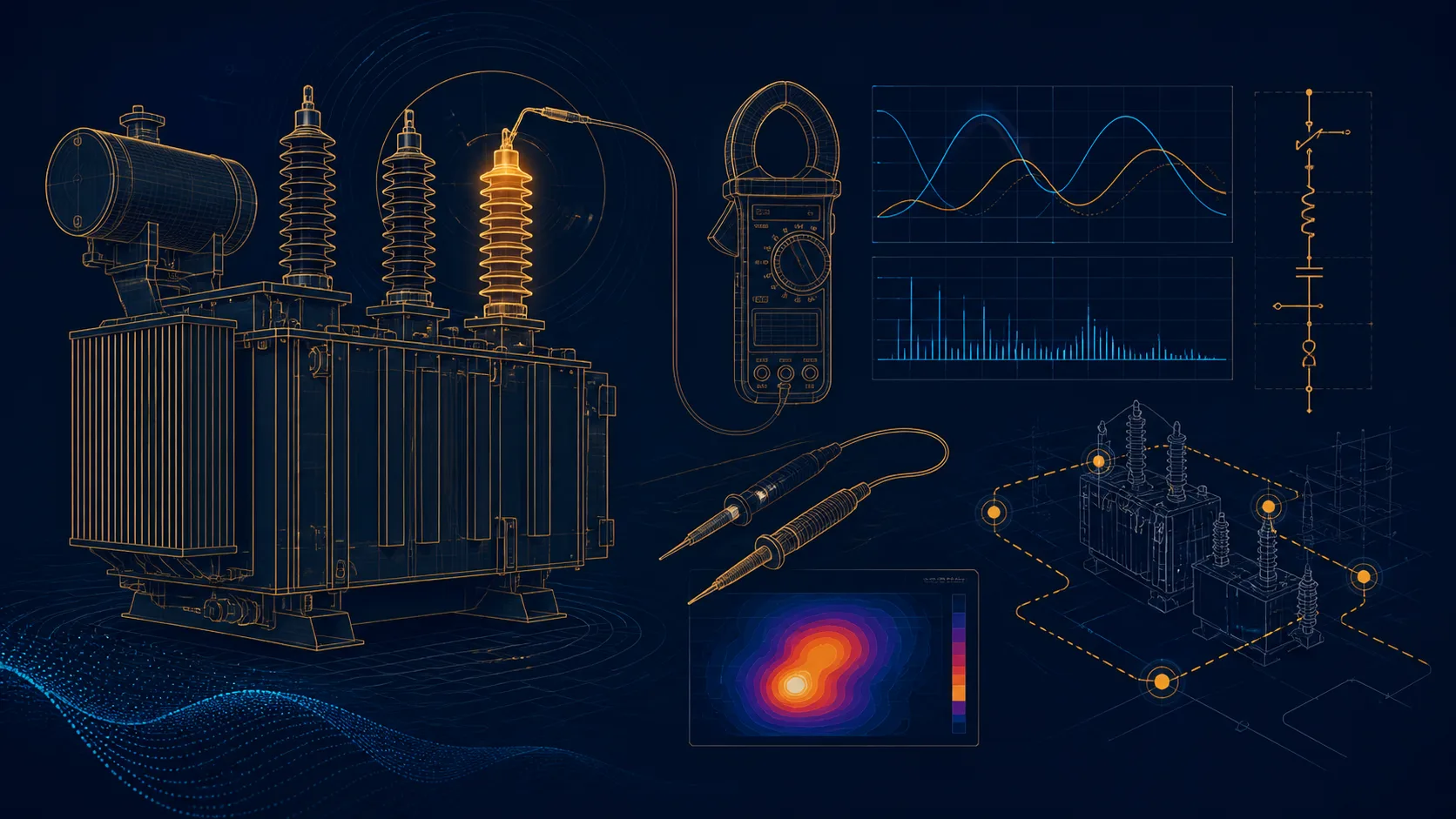
Illustrated transformer testing and electrical diagnostic measurements

Overview

Engineering scope built around the project

Periodic electrical testing and diagnostic health assessments are critical to identifying equipment wear, insulation deterioration, and protection miscoordination before unplanned outages occur. DV Consultancy Services provides on-site diagnostic testing services across Nagpur and Vidarbha.

Our field testing procedures utilize calibrated diagnostic test kits to evaluate key high-voltage and low-voltage assets, including transformers, circuit breakers, protection relays, and grounding networks.

We deliver clear, structured test reports comparing measured parameters against manufacturer standards and accepted industry benchmarks, supporting preventive maintenance decisions and pre-commissioning verification.

Technical scope

What the engagement may cover

1. Transformer Diagnostic Testing

  • Insulation Resistance (IR) and Polarization Index (PI) measurements up to 5kV DC.
  • Turns ratio (TTR) and vector group verification across tap positions.
  • Winding resistance measurement to detect loose internal connections.
  • Transformer insulating oil dielectric breakdown voltage (BDV) testing.

2. Circuit Breaker Testing (VCB / ACB / SF6)

  • Contact resistance measurement (CRM) using micro-ohmmeters to evaluate main contact health.
  • Breaker opening, closing, and contact transit timing analysis.
  • Vacuum bottle dielectric integrity testing on vacuum circuit breakers.
  • Operational checks on spring charging motors, trip coils, and close coils.

3. Protection Relay Testing & Calibration

  • Secondary current and voltage injection testing on numerical and electromechanical relays.
  • Verification of pick-up thresholds, drop-off ratios, and IDMT trip timing curves.
  • Testing of master trip relays (86) and trip circuit supervision (95) functions.
  • Coordination check against approved protection setting schedules.

4. Earth Resistance & Thermography Scanning

  • Individual earth pit and grid resistance measurement using the 3-point fall-of-potential method (IS 3043).
  • Earth continuity testing between equipment chassis and the main grounding grid.
  • Infrared thermographic inspection of loaded busbar joints and cable terminations to identify localized thermal hotspots.

A clear engineering process

01

Isolation & Safety Procedures

Implementation of Lockout/Tagout (LOTO) protocols and multi-point verification of zero voltage prior to connecting test leads.

02

Diagnostic Testing Execution

Conducting planned test sequences in accordance with relevant Indian and international standards using calibrated equipment.

03

Data Analysis & Benchmark Comparison

Comparing measured results against equipment nameplate ratings, previous baseline records, and standard limits.

04

Comprehensive Test Documentation

Issuing formal test certificates with clear pass/fail status, data tables, and recommended corrective maintenance actions.

Standards and project context

References below guide the technical conversation. The final applicable standards, authority requirements and issue dates must be confirmed for each project.

  • IS 2026 / IEC 60076: Power Transformers
  • IS 13118 / IEC 62271: High-Voltage Circuit Breakers
  • IS 3231 / IEC 60255: Electrical Protection Relays
  • IS 3043: Code of Practice for Earthing Testing

Common client contexts

Industrial Manufacturing FacilitiesPower Distribution SubstationsElectrical Contractors & EPC FirmsCommercial Complexes & HospitalsContinuous Process Plants

Frequently asked questions

How often should industrial distribution transformers undergo diagnostic testing?

In line with standard preventive maintenance guidelines and regulatory recommendations, insulation resistance (IR), oil dielectric breakdown voltage (BDV), and protection relays should be inspected at least once every 12 months, with additional sampling after significant overload or tripping events.

What is the significance of Dissolved Gas Analysis (DGA) in transformer oil?

DGA detects trace combustible gases dissolved in insulating oil resulting from electrical or thermal stress (e.g. hydrogen from partial discharge, acetylene from arcing, ethylene from high-temperature overheating), serving as an early diagnostic indicator before major faults develop.

What is an acceptable earth resistance value for an electrical installation?

As per IS 3043 guidelines, an industrial HT substation combined earth grid resistance should ideally be below 1.0 Ohm, while individual low-voltage equipment body earth pits should generally be maintained below 2.0 to 5.0 Ohms.

Related services

Residential

Residential Electrical Design

Engineered, energy-efficient, and IS 732-compliant electrical layouts and single-line diagrams for residences, villas, and housing societies.

  • Connected & Maximum Demand Load Calculations
  • Internal Conduit, Lighting & Power Point Layouts
  • Main Distribution Board (MDB) & Sub-DB Schematic SLDs
Explore service
Commercial

Commercial Electrical Design

High-reliability power distribution, backup generator synchronization, and life-safety electrical schemes for commercial and healthcare facilities.

  • Substation Layout & Dual Incomer Switchboard Schematics
  • Standby Generator (DG) & UPS Synchronization Schemes
  • Isolated Power Supply (IPS) Concepts for Critical Care Areas
Explore service
Industrial

Industrial Electrical Setup

HT substation design (up to 33kV), Motor Control Centers (MCC), power factor correction systems, and heavy-duty industrial earthing.

  • 11kV / 33kV Outdoor Yard & Indoor Substation Layouts
  • Power & Distribution Transformer Sizing Specifications
  • Vacuum Circuit Breaker (VCB) & HT Protection Schemes
Explore service
Project conversation

Need help planning equipment testing & calibration?

Share the project stage, available drawings and site constraints. We will use that context to frame the next engineering step.

Discuss your requirement