Commercial

Commercial Electrical Design

Power Availability, Backup Engineering & Intelligent Building Distribution

Discuss this service
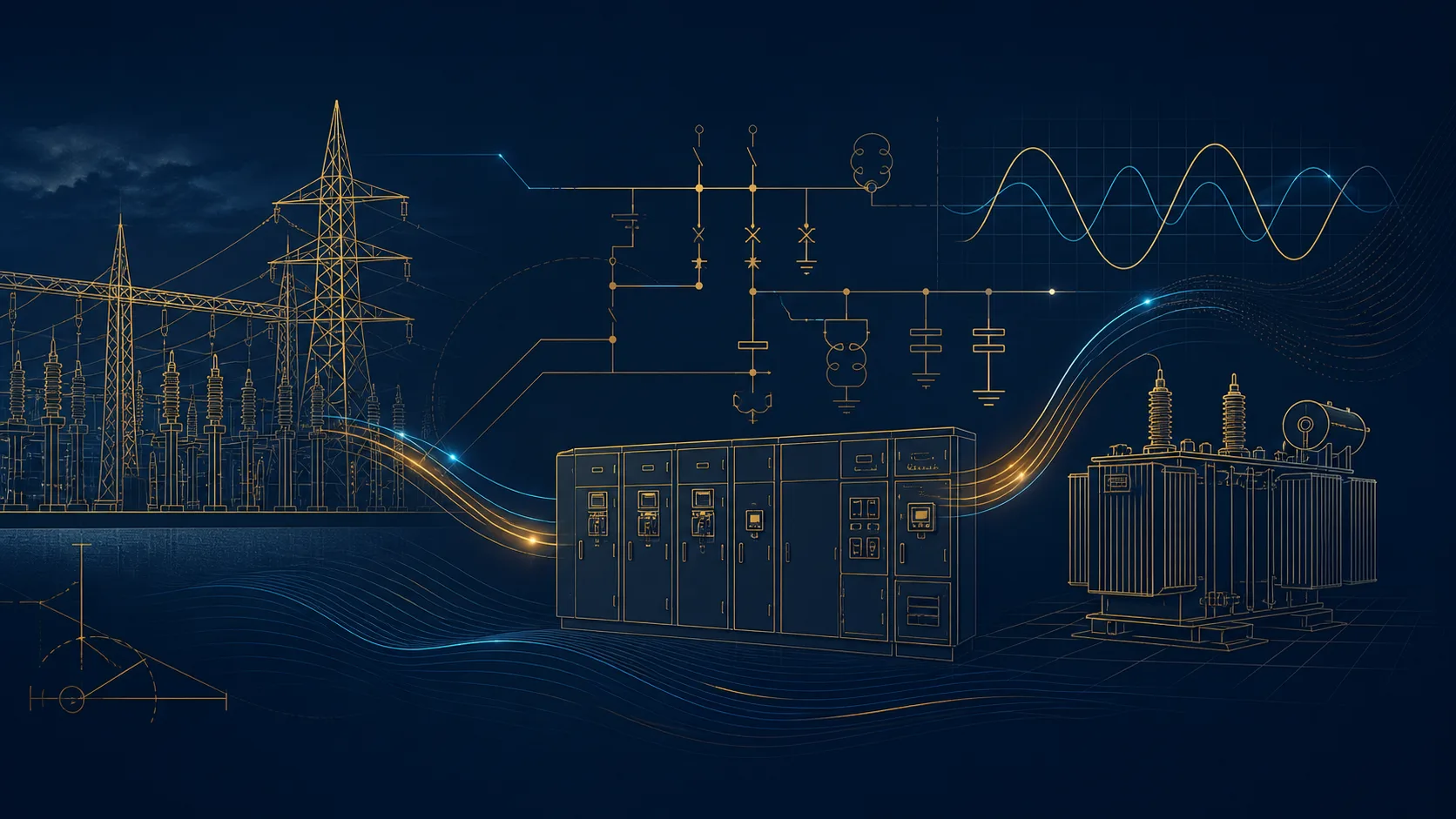
Illustrated electrical distribution system, switchgear and transformer

Overview

Engineering scope built around the project

Commercial establishments depend on stable, continuous power to maintain day-to-day operations, electronic data systems, and life-safety equipment. DV Consultancy Services provides technical design for commercial power distribution systems throughout Nagpur and Central India.

Our commercial design capabilities encompass medium-voltage indoor substations, automatic transfer switches (ATS), generator synchronizing schemes, and uninterruptible power supply (UPS) distribution networks.

For healthcare and specialized institutions, our designs incorporate isolated power supply concepts, medical-grade earthing, and fire-resistant emergency circuits developed with reference to applicable National Building Code and safety regulations.

Technical scope

What the engagement may cover

1. Reliable Power Distribution

  • Dual incomer main LT switchboard engineering with mechanical and electrical interlocking.
  • Automatic Mains Failure (AMF) and Auto Transfer Switch (ATS) changeover logic.
  • K-factor transformer rating recommendations to manage non-linear harmonic loads from IT equipment.

2. Busduct & Vertical Rising Mains

  • Sandwich busway system sizing for vertical and horizontal power distribution in multi-story buildings.
  • Plug-in tap-off box distribution with MCCB protection for floor-by-floor isolation.
  • Coordinated fire barrier specifications for floor and wall penetrations.

3. Healthcare & Specialized Facility Electrical

  • Isolated power supply (IPS) design concepts and insulation monitoring for critical healthcare areas.
  • Equipotential bonding networks and dedicated clean earthing for sensitive diagnostic equipment.
  • Dual-redundant feeder routing to critical operation theaters and intensive care units.

4. Energy Management & Metering

  • Multi-function digital energy meter networking for sub-system consumption monitoring.
  • Zoned lighting controls with occupancy and daylight sensors.
  • Power factor correction panels with detuned harmonic filter reactors.

A clear engineering process

01

Load Classification

Categorization of loads into Critical (UPS), Essential (Emergency DG), and Non-essential feeders with diversity modeling.

02

Fault Level & Discrimination Study

Calculation of prospective short-circuit currents to determine suitable switchgear breaking capacities and relay coordination.

03

Detailed Engineering Packages

Preparation of substation layouts, cable tray routing, panel general arrangement (GA) drawings, and earthing layouts.

04

Statutory Submission Support

Assistance in assembling technical documentation packages for review by the Electrical Inspectorate.

Standards and project context

References below guide the technical conversation. The final applicable standards, authority requirements and issue dates must be confirmed for each project.

  • IS 732: Electrical Wiring Code
  • NBC Part 4 & 8: Fire & Life Safety and Building Services
  • IS/IEC 60364: Electrical Installations in Buildings
  • IEEE 446: Recommended Practice for Emergency and Standby Power Systems

Common client contexts

Commercial Office Towers & IT ParksHospitals & Healthcare ClinicsShopping Centers & Retail ComplexesHotels, Banquet & Hospitality FacilitiesEducational Institutions & Universities

Frequently asked questions

How do you categorize essential vs. critical loads for commercial standby power?

We classify loads into critical (data infrastructure, emergency lighting, life-safety alarms requiring UPS backup), essential (elevators, water pumps, ventilation, key refrigeration powered by standby generators), and non-essential (comfort cooling, decorative lighting) which can be shed during power interruptions.

What is an Isolated Power Supply (IPS) in medical facilities?

An IPS (Medical IT System) uses an ungrounded isolation transformer and continuous insulation monitoring to supply power to critical care locations, preventing sudden power disconnection upon a single earth fault and reducing electrical shock hazards.

What cable fire-safety ratings are recommended in commercial buildings?

In line with NBC recommendations, Flame Retardant Low Smoke (FRLS) or Low Smoke Zero Halogen (LSZH) cables are standard for internal distribution, with circuit-integrity fire-rated cables specified for emergency egress lighting, fire pumps, and smoke evacuation fans.

Related services

Residential

Residential Electrical Design

Engineered, energy-efficient, and IS 732-compliant electrical layouts and single-line diagrams for residences, villas, and housing societies.

  • Connected & Maximum Demand Load Calculations
  • Internal Conduit, Lighting & Power Point Layouts
  • Main Distribution Board (MDB) & Sub-DB Schematic SLDs
Explore service
Industrial

Industrial Electrical Setup

HT substation design (up to 33kV), Motor Control Centers (MCC), power factor correction systems, and heavy-duty industrial earthing.

  • 11kV / 33kV Outdoor Yard & Indoor Substation Layouts
  • Power & Distribution Transformer Sizing Specifications
  • Vacuum Circuit Breaker (VCB) & HT Protection Schemes
Explore service
Testing

Equipment Testing & Calibration

Diagnostic electrical testing for circuit breakers, transformers, protection relays, HT cables, and earth pits using calibrated instruments.

  • Transformer Oil Breakdown Voltage (BDV) & Dissolved Gas Analysis (DGA) Advisory
  • Transformer Winding Resistance, Voltage Ratio & Magnetic Balance Testing
  • Insulation Resistance (IR) & Polarization Index (PI) Testing
Explore service
Project conversation

Need help planning commercial electrical design?

Share the project stage, available drawings and site constraints. We will use that context to frame the next engineering step.

Discuss your requirement